The Filtering & Monitoring Review
The Filtering & Monitoring Review
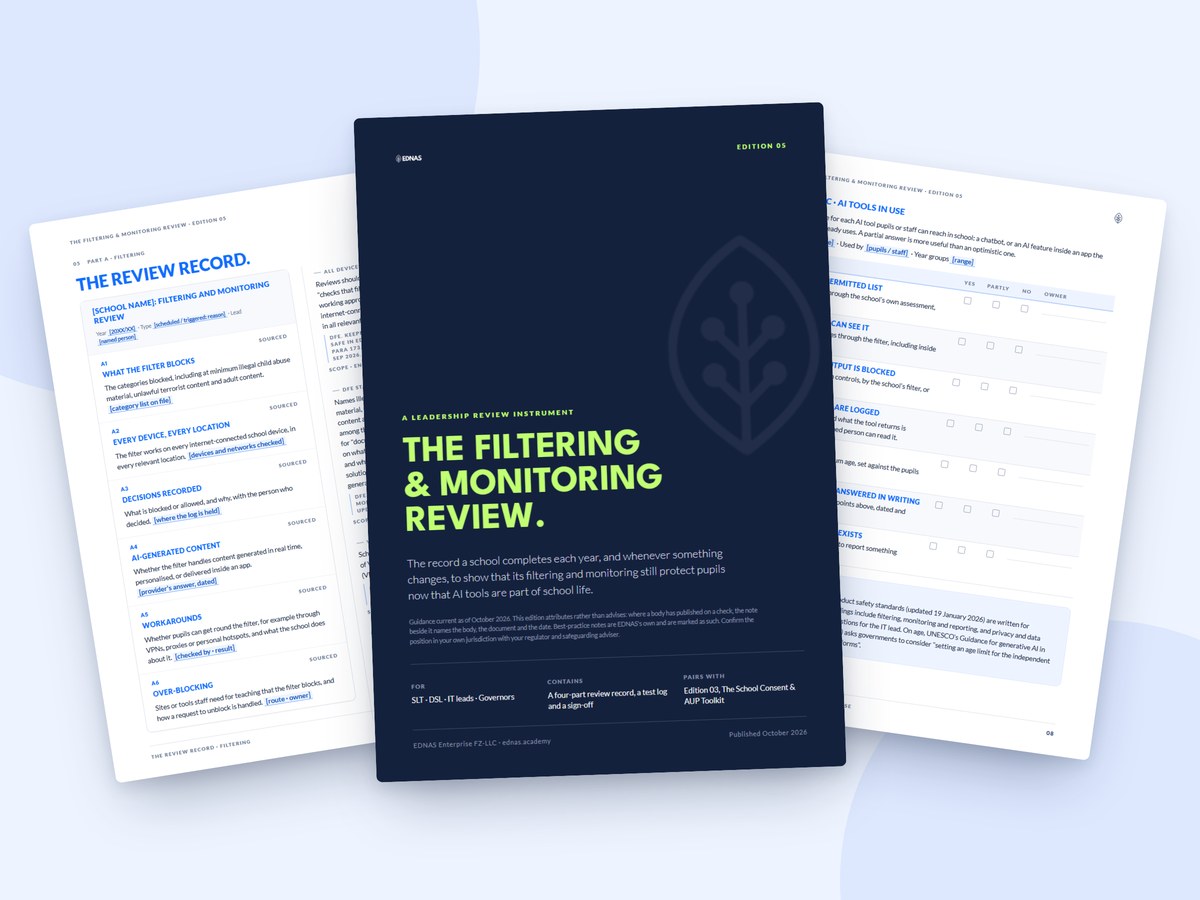
The record a school completes each year, and whenever something changes, to show that its filtering and monitoring still protect pupils now that AI tools are part of school life. Every check states whether a body has published on it, and names the body, document and date where one has.
- Inside
- 6 sections, a four-part review record, 13 pages
- For
- SLT, DSL, IT leads and governors
What's inside
01Why review, with AI in scope
What a filtering and monitoring review is for, and why AI tools now sit inside it.
1 page02When to review
At least once a year, and whenever something changes. The triggers, named.
1 page03Who owns it
Six roles, from the SLT lead who signs the review to the staff who report what gets through.
1 page04What is in scope
Filtering and monitoring set side by side, with four AI questions for every system.
1 page05The review record
Four parts: filtering, monitoring, the AI tools in use, and the test log.
4 pages06Decisions and sign-off
Actions, owners, accepted risks, the next review date and signatures.
1 page
Scope and applicability
This edition attributes rather than advises. Where a named body has published on a check, the note beside it gives the body, the document and the date. Where none has, the field is carried and nothing is claimed. A jurisdiction reference panel covers England, UK sector guidance, Abu Dhabi, the United States and UNESCO.
Guidance current as of October 2026. Schools should confirm the position in their own jurisdiction with their regulator and safeguarding adviser.
Contemporary references include
- DfE Filtering and monitoring standards, updated 16 Sep 2026
- Keeping Children Safe in Education 2026 (England)
- DfE Generative AI: product safety standards, updated 19 Jan 2026
- UK Safer Internet Centre, Appropriate Filtering and Monitoring, 2026
- ADEK School Policy on Digital, v1.1
- Children's Internet Protection Act (US)
- UNESCO Guidance for generative AI in education and research, 2023